Pocket Notebook or Progress App: Choose a Record You’ll Revisit
Compare a pocket notebook with a progress app, then choose a simple way to capture useful observations and revisit them when a decision needs context.
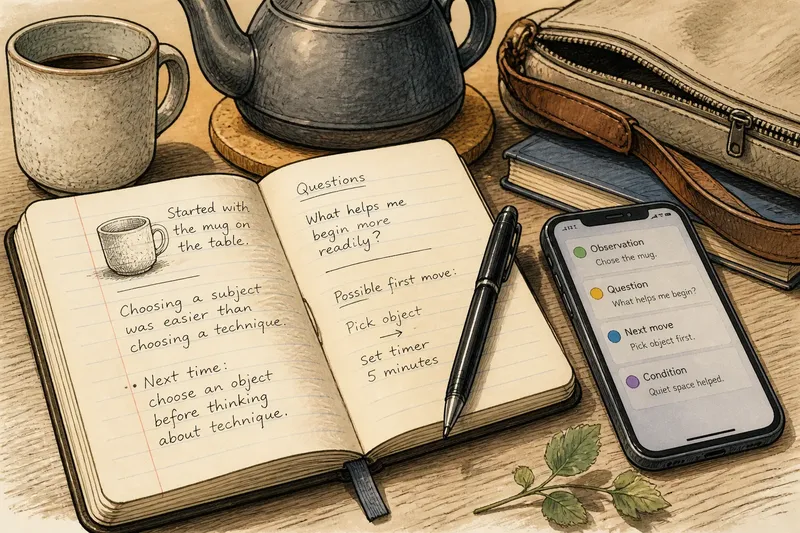
A pocket notebook beside the kettle can catch the thought you meant to keep before breakfast carries you towards the door. A progress app can store the same observation, but the choice is less about which came first than which format helps you notice, record and revisit what matters.
Choose a record for the job it needs to do
A personal record can hold a question, a small observation or a note about what made a task easier. It need not tell the story of an entire day or turn every intention into a target.
Commonplace books and diaries offer two useful ways to organise notes. A commonplace book gathers material by topic or interest; a diary usually places entries in time. These are practical distinctions, not rules: one notebook can contain both a copied idea and a dated reflection.
For personal development, the useful question is what you want to recall later. “The instructions were unclear, so I paused” gives more to work with than “bad session”. A brief note can keep a detail available without making it a judgement about your character.
Compare a pocket notebook with a progress app
A pocket notebook is easy to open without first seeing a screen. It can sit beside a book or travel in a bag, and a page left open may remind you of a question. Its drawback is that finding an old note usually means turning pages.
A progress app can make notes searchable and available on a device. Depending on the app and its settings, it may also offer reminders or access from more than one device. Notifications and other phone prompts can interrupt writing, while storage and privacy arrangements vary between services.
Think of a notebook as a small dish for a loose button: it gives an idea a place to stay, but does not decide what you should do with it. Paper can suit quick, private observations; an app can suit notes you expect to retrieve or share. Some people use both, but copying every note across can turn reflection into extra administration.
Make entries specific enough to use
Write down a concrete detail, a question or a possible next move. “Read the instructions twice; still unsure where to begin” is easier to revisit than “I’m hopeless at this”. You do not need polished prose, a special notebook or a daily ritual.
When a plan changes, record what happened and the context you can actually observe. “Did not read; the book was in another room, and I had no clear place to pause” preserves more useful information than a verdict about your discipline.
Say you are learning to draw and have been putting off practice. After a session, you write, “Started with the mug on the table; choosing a subject was easier than choosing a technique.” Next time, you decide to choose an object before thinking about technique; the observable result will be whether that first decision helps you begin more readily. One entry offers a possibility to try, not proof that the approach will always work.
Use a quick check to decide what belongs in the record
Before writing, consider what you may want to remember and what decision the note could support. These prompts help keep an entry useful without requiring a full diary.
- Check whether you can name what held your attention; if you can, record that detail, then consider whether it suggests a useful starting point, otherwise note what interrupted you.
- Check whether a task felt difficult because its first move was unclear; if it was, write down a possible first move to try next time, otherwise note the specific obstacle that remained.
- Check whether the plan changed and what observable event changed it; if you can identify the event, record it and consider adjusting the plan, otherwise leave the cause open rather than guessing.
- Check whether something helped you continue, such as having materials ready; if it did, note that condition and consider repeating it, otherwise record what you tried without claiming it helped.
- Check whether the note could inform a choice you expect to make; if it could, keep it where you can revisit it, otherwise leave it out or let it remain a passing thought.
- Check whether the entry includes private details you do not need; if it does, remove them or choose a more suitable place to store the note, otherwise keep the entry as written.
Revisit notes when a decision needs context
Look back when you are considering a change to a learning plan, a place to work or a response to a recurring difficulty. Reading notes by date can show how an idea developed; scanning for repeated words can bring a possible theme into view.
Keep the interpretation modest. Several notes may give you a question to explore, but a small personal record cannot explain every cause. If an old page feels stale or too private to revisit, you can leave it alone, cover it or start fresh.
How do you choose and maintain a reflection record?
What should I write in a reflection notebook?
Record an observation, question or detail that could help you understand an experience or make a later choice. Skip entries that feel like record-keeping for its own sake.
Is a pocket notebook better than a progress app?
Neither suits everyone: paper offers a visible place for brief thoughts, while an app may make saved notes easier to search. Choose according to the access, privacy and kind of attention you want.
How can I keep note-taking from becoming another task?
Make entries optional and brief, and write only when there is something you want to remember. If the practice starts to feel like a performance, pause or change formats.
What should I do with old entries?
Return to a note when it could inform a current decision, and leave the rest alone. Keep, discard or protect pages according to their usefulness and your comfort with their privacy.
Let the record serve the reflection
A notebook is a tool, not a measure of your worth. Blank pages do not prove that you have failed to reflect, and a full notebook does not prove that every intention has been acted on.
For a pocket notebook or progress app to earn its place, it should help you recall a detail when you need it. Give the record a convenient home, keep sensitive notes in a place you are comfortable using, and let each entry offer a clue rather than a verdict.