The Perfect Cue Myth
The perfect cue myth makes routines brittle. Learn how flexible habit cues can help you begin when work, energy or the shape of your day changes.
You planned to stretch after breakfast, but the kettle boiled over, a message arrived and breakfast became a banana eaten beside the door. By evening, the routine has vanished—not because you lacked resolve, but because the moment you chose never appeared. The perfect cue myth says a habit needs one reliable trigger; in practice, a flexible habit cue can make it easier to begin when the day shifts.
A cue points towards a routine; it does not have to command it
A cue is something you notice that can remind you what to do next. It might be an event, a place, an object or a sensation: closing your laptop, arriving home, seeing your running shoes, or feeling your shoulders tighten. The cue supplies a prompt, not a promise that the rest of the day will cooperate.
It helps to separate three parts that often get bundled together. The cue is the signal; the routine is the action you intend to practise; and the response is what you actually do in that moment. If you planned to read after lunch but lunch ran late, you can still read when you finish work. The routine remains recognisable even though its prompt has changed.
A cue works best when it is noticeable and connected to the action. “When I have a quiet day” is vague: quiet can mean different things, and it may never arrive. “When I put my mug in the sink” is easier to recognise, though it may be unavailable if you are out. Neither cue is inherently superior; each fits a different life.
Why one perfect trigger can make a habit fragile
Routines are often attached to a neat sequence: wake, shower, coffee, journal. That can be useful while the sequence holds, but a disrupted link may make the whole plan feel unavailable. A late start, a different commute or an overnight guest can remove the chosen trigger without removing the chance to do the habit.
This is the weakness in the perfect cue myth. It treats consistency as if it means repeating the same minute and setting, when consistency can instead mean returning to the same action after circumstances change. A flexible cue gives the routine more than one doorway. Think of a keyring rather than a single key: several cues can open the same small action, while the action itself stays familiar.
Flexibility does not mean turning every spare moment into a prompt. If every notification, passing thought and patch of free time counts as a cue, the signal becomes noise. Choose a small number of cues that are easy to notice and plausibly linked to the routine. The aim is not to be perpetually on alert; it is to have an alternative when the usual moment slips away.
Build a cue family around one clear action
Start by naming the routine in plain terms. “Look after myself” is too broad to prompt a specific response; “write one line in my journal” is clear. Then identify the kinds of ordinary moments that could make that action easy to remember.
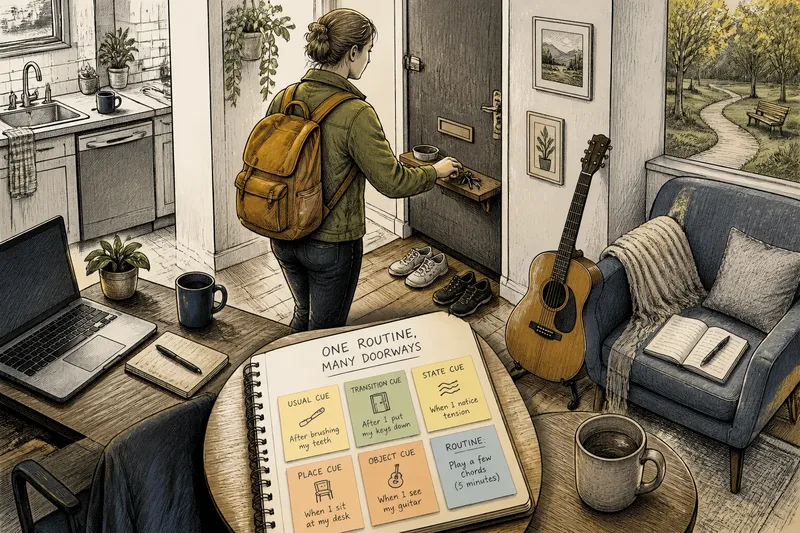
- Sequence cues: after brushing your teeth, once you close your laptop, or when you put dinner dishes aside.
- Place cues: when you sit at your desk, enter the kitchen, or arrive at the park.
- Object cues: when you see a book beside your chair, pick up your guitar, or open a notebook.
- Transition cues: after a meeting ends, when you get home, or before you move from work to leisure.
- State cues: when you notice restlessness, mental fog or tension in your shoulders, if that state reliably suits the action.
These are possibilities, not a checklist of signals to adopt. A cue family should fit your circumstances and the nature of the habit. A short breathing pause might suit a transition or a feeling of tension; language practice might fit opening a lunch box or sitting on a train. A routine that needs equipment, privacy or concentration may have fewer workable cues, and that is useful information rather than a personal failing.
Say you want to practise a few chords on the guitar, usually after work. Imagine a day when your shift ends late and you go straight to collect a parcel. You might use “after I put my keys on the hall shelf” as another cue; if the guitar is accessible and you have a suitable moment, you can practise then. The observable result is simple: the action has a second possible starting point, rather than depending only on the end of work.
Make alternatives specific without making them rigid
A flexible plan can still be precise. One useful form is: “After my usual cue, I will do the routine; if that moment is missed, I will look for one of these two alternatives.” The alternatives should be recognisable events, not a demand to squeeze the habit into any gap at any cost.
For instance, a person who wants to review new vocabulary might normally begin after breakfast. Their alternatives could be after opening their lunch container or after putting their work bag down at home. They still need to decide whether the setting allows them to concentrate. The cue prompts a choice; it does not overrule practical judgement.
Keep the action itself steady while you vary its prompt. If the routine changes from reading a page to reorganising your shelves, the cue family no longer points to one clear behaviour. On the other hand, the routine can have a modest version for constrained moments, provided it still counts as the same practice. Decide what that version is in advance, rather than inventing a new standard every time the day gets busy.
A good alternative is also easy to remember. Two or three plausible cues are usually clearer than a long catalogue of possibilities. If you find yourself scanning the room for something that might count, simplify the plan: keep the usual cue and choose one alternative tied to a transition that already happens in your day.
Notice whether a cue helps you start or adds friction
A cue is useful when it makes the next action easier to recognise. It can become unhelpful if it arrives while you are driving, handling a demanding task or trying to sleep. In that case, the signal may be noticeable but poorly timed. Choose another moment that gives you a reasonable chance to respond.
It also matters whether the cue is under your control. “When my colleague reminds me” depends on another person; “when I close the shared document” may be more dependable. Some cues will still rely on changing circumstances. That is why a backup can be helpful, but a backup should not turn into an elaborate system that takes more effort than the habit.
Look at what happens when the routine is missed. If you notice the missed cue and can name a suitable alternative, the plan may need a broader set of signals. If the cue appears repeatedly but the action feels unwelcome, adding more prompts is unlikely to solve the real problem. The routine may be too demanding, poorly timed or no longer relevant. Adjust the action or its setting rather than blaming yourself for failing to respond.
Reflection can stay brief. After a disrupted day, ask: “What signal did I expect? Was it available? What other ordinary event could have pointed me towards the same action?” You are looking for a practical adjustment, not a verdict on your character. If no alternative was suitable, it can be reasonable to resume at the next fitting opportunity.
Which cues work when a day changes?
Should I use the same cue every day?
Use the same cue when it naturally occurs and gives you a suitable chance to begin. A backup cue can help when that moment is displaced, without requiring you to replace a routine that already works.
Can a feeling or mood be a habit cue?
It can, if you can recognise the feeling and the routine is appropriate in that moment. Because moods can be hard to predict, pair an internal cue with an ordinary event if you need a more concrete reminder.
How many alternative cues should I choose?
Choose only enough to cover realistic changes in your day. A small set of clear alternatives is easier to remember than a collection of possible prompts that makes every moment feel like a test.
What if I miss every cue?
Consider whether the cues are visible, timely and connected to a genuine opportunity to act. If they are, but the routine still does not fit, make the action easier to approach or reconsider whether it belongs in your current routine.
Let the signal bend while the intention stays clear
The perfect cue myth can make an ordinary interruption look like a broken habit. A more useful view is that cues are reminders you can arrange around real life, not a strict timetable that life must obey. Keep the routine recognisable, choose signals you can actually notice and allow one practical alternative for a day that changes shape.
When you next miss the moment you planned, do not rush to build a complicated system. Identify the next natural transition, ask whether it offers a suitable opening, and let it serve as a new prompt if it does. Flexible habit cues are most useful when they quietly return your attention to the action—without asking you to wait for a perfect day.